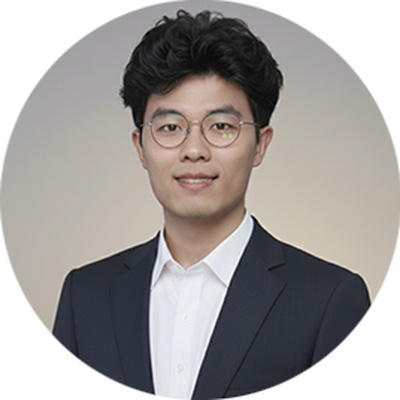
I am a Ph.D. student at the School of Architecture, Tsinghua University, advised by Prof. Ying Long, and a member of Beijing City Lab (BCL). I received my B.Eng. in Urban Planning from Hefei University of Technology in 2023.
My research focuses on building-scale urban analytics and simulation, LLM/VLM evaluation and alignment, and multi-agent systems. I build large-scale urban datasets, evaluate generative AI for scientific discovery, and develop open-source research systems. I have published papers in SCI/SSCI journals and CCF-A conferences including ECCV, Scientific Data, AAAI, CVPR, Habitat International, Building Simulation, and iScience, with a first/corresponding-author paper in 2nd-round review at Nature Communications. See my Google Scholar profile for current citations; my open-source datasets have received 45,000+ downloads, including 2 ESI Highly Cited Papers.
我是清华大学建筑学院博士生,导师为龙瀛教授,北京城市实验室 (BCL) 成员。2023年获合肥工业大学城乡规划学士学位。
研究方向包括建筑尺度城市分析与模拟、大模型评测与对齐和多智能体系统。致力于构建大规模城市数据集,评估生成式AI的科学发现能力,并开发开源研究系统。已在 ECCV、Scientific Data、AAAI、CVPR、Habitat International、Building Simulation、iScience 等SCI/SSCI期刊和CCF-A会议发表论文,另有第一/通讯作者论文在 Nature Communications 二审。当前引用情况见 Google Scholar;开源数据集累计 45,000+ 次下载,含 2篇ESI高被引论文。
清華大学建築学院の博士課程に在籍し、龍瀛教授の指導を受けています。北京城市実験室 (BCL) のメンバーです。2023年に合肥工業大学にて都市計画の学士号を取得しました。
研究分野は建築スケール都市分析・シミュレーション、LLM/VLMの評価とアライメント、マルチエージェントシステムです。大規模都市データセットを構築し、科学的発見のための生成AIを評価するとともに、オープンソース研究システムを開発しています。ECCV、Scientific Data、AAAI、CVPR、Habitat International、Building Simulation、iScience などのSCI/SSCI誌やCCF-A会議に論文を発表し、Nature Communications に第2回査読中の筆頭/責任著者論文があります。最新の引用状況は Google Scholar を参照してください。オープンソースデータセットは累計 45,000回以上 ダウンロードされ、ESI高被引用論文2本 を含みます。
Research Vision研究愿景研究ビジョン
BUILDING-SCALE URBAN ANALYTICS & SIMULATION
Buildings are the basic cells of urban systems.
I connect building engineering with urban science through data foundations, generative AI, and bottom-up simulation.
建筑尺度城市分析与模拟
建筑是城市复杂系统的基本细胞。
通过数据底座、生成式人工智能和自下而上的模拟,连接建筑研究的语义深度与城市科学的地理广度。
建築スケール都市分析・シミュレーション
建築は都市複雑系を構成する基本単位です。
データ基盤、生成AI、ボトムアップ・シミュレーションを通じて、建築研究と都市科学を接続します。
Open-source Systems开源系统オープンソース・システム
| Project项目プロジェクト | What it does主要贡献主な機能 | Evidence链接リンク |
|---|---|---|
| Research systems研究系统研究システム | ||
| AI4UrbanScience | Evaluate and calibrate GenAI for urban-science data synthesis.评测并校准生成式AI的城市科学数据合成能力。都市科学データ生成における生成AIを評価・校正。 | Paper · Code |
| UrbanAlign | Training-free VLM–human preference alignment.免训练的视觉语言模型与人类偏好对齐。学習不要のVLM–人間選好アライメント。 | ECCV 2026 · Code |
| AI productsAI产品AIプロダクト | ||
| MemoMind | Persistent, local memory and evolving knowledge graphs for AI agents.面向AI智能体的本地持久记忆与演化知识图谱。AIエージェント向けローカル永続メモリと進化型知識グラフ。 | GitHub |
| HumanSkillTree | AI-powered lifelong learning grounded in cognitive science.基于认知科学的AI终身学习系统。認知科学に基づくAI生涯学習システム。 | GitHub |
| Zync | An IDE for orchestrating multiple coding agents in parallel.并行编排多个编程智能体的IDE。複数のコーディングエージェントを並列編成するIDE。 | GitHub |
| DigitalMe | Control coding agents from Feishu, Telegram, or Slack.通过飞书、Telegram或Slack远程控制编程智能体。Feishu、Telegram、Slackからコーディングエージェントを操作。 | GitHub |
| SmartBidding 🔒 | Production engineering-bid intelligence platform for OCR, structured review, retrieval, generation, and audit.面向工程投标的生产级智能审查与生成平台,覆盖OCR、结构化审查、检索、生成与审计。OCR、構造化レビュー、検索、生成、監査を備えた入札インテリジェンス基盤。 | GitHub |
| Infrastructure and data基础设施与数据基盤とデータ | ||
| AI API Gateway 🔒 | Private model routing, shared-service access, device isolation, and credential-control architecture.私有模型路由、共享服务接入、设备隔离与凭据控制架构。プライベートモデルルーティング、共有サービス接続、デバイス分離、認証情報管理。 | GitHub |
| GEHI Batch Router | Restartable historical-imagery routing with actual-date provenance, quality gates, and auditable manifests.支持断点续跑的历史影像路由,记录实际日期、质量门禁与可审计血缘。実取得日、品質ゲート、監査可能なマニフェストを備えた再開可能な歴史画像ルーティング。 | GitHub |
| DayLife | Local-first personal activity understanding and AI-assisted reflection.Local-first 的个人活动理解与AI辅助反思系统。ローカルファーストな個人活動理解とAI支援リフレクション。 | GitHub |
Supporting systems include InfoHub, web-novel-crawler, HomeSync, Desktop Controller, Recall, Prompt Harness, Experiment Log, Note2Video, AI Reviewer, CiteMind, and k2md.配套系统包括 InfoHub、web-novel-crawler、HomeSync、Desktop Controller、Recall、Prompt Harness、Experiment Log、Note2Video、AI Reviewer、CiteMind 与 k2md。関連システムには InfoHub、web-novel-crawler、HomeSync、Desktop Controller、Recall、Prompt Harness、Experiment Log、Note2Video、AI Reviewer、CiteMind、k2md があります。
Explore the complete project catalog →查看完整项目列表 →全プロジェクト一覧を見る →
News动态ニュース
- 2026.06: Paper “UrbanAlign” accepted at ECCV 2026.
- 2026.06: Paper “Towards building-scale urban analytics and simulation” published in Building Simulation (SCI Q1).
- 2026.04: Ghost Cities paper recognized as ESI Highly Cited Paper in Social Science, Habitat International.
- 2026.04: Paper “DAPE: Dual-Stage Parameter-Efficient Fine-Tuning for Consistent Spatial and Temporal Representation” accepted at CVPR 2026 Findings. Project Page
- 2026.01: Our research on global ghost cities reported by Popular Mechanics (one of the most influential popular science media in the US).
- 2025.11: Paper “WaveC2R” accepted at AAAI 2026 (CCF-A).
- 2025.11: CMAB paper recognized as ESI Highly Cited Paper in Geoscience.
- 2025.11: “新城市科学” paper listed in CNKI Top 20 Most-Cited Papers (2024-2025) in 城市规划 CITY PLANNING REVIEW.
- 2025.11: Received “GIS Rising Star” Award (10 nationwide) & chaired the Rising Star session at The 13th China College GIS Forum, Shanghai.
- 2025.10: Our paper “GenAI Models Capture Urban Science…” entered 2nd round review at Nature Communications.
- 2025.10: Poster at China Urban Planning Informatization Annual Conference, Foshan.
- 2025.10: Received Jin Jingchang Outstanding Paper Award (佳作奖, 22nd edition), Shanghai.
- 2025.08: Recognized as Outstanding Teaching Assistant (Top 5%) at Tsinghua University.
- 2025.06: CMAB research featured on Tsinghua University’s official Facebook account.
- 2025.05: Nominated for “Academic Rising Star” (学术新秀) at Tsinghua University (10 university-wide, sole nominee from School of Architecture).
- 2025.05: Exhibitor at China Pavilion, 19th Venice Architecture Biennale, Venice, Italy.
- 2025.03: Presented at AAG 2025, Detroit, USA.
- 2025.01: Paper “CMAB” published in Scientific Data — 45,000+ downloads.
- 2025.01: Received Outstanding Case Award for “AI-Empowered Planning” from Urban Planning Society of China.
- 2024.12: Paper “Inferring Ghost Cities” published in Habitat International.
- 2024.11: Presented at Tsinghua University “Future Urban Construction” Ph.D. Forum, Beijing.
- 2024.06: Invited talk at Applied Urban Modelling (AUM2024), University of Cambridge, UK.
- 2024.01: Attended NSFC Major Project Kick-off Meeting, Guangzhou.
- 2023.08: Presented at The First Research Summit of Urban Science, Beijing.
- 2023.08: Presented at Global Smart Cities Summit (GSCS) & 3rd International Conference on Urban Informatics (ICUI), Hong Kong.
- 2023.07: Presented at UIA World Congress of Architects, Copenhagen, Denmark.
- 2023.06: Teaching assistant at Tongji University Architectural DigitalFUTURES workshop “Emerging Planetarism”, Shanghai.
- 2023.05: Exhibitor at China Pavilion, 18th Venice Architecture Biennale, Venice, Italy.
- 2022.09: Presented at CUSR Urban Big Data Annual Meeting, Beijing.
- 2022.07: Presented at 4th International Conference on Computational Design and Robotic Fabrication, Shanghai.
- 2026.06: 论文 “UrbanAlign” 被 ECCV 2026 录用。
- 2026.06: 论文 “Towards building-scale urban analytics and simulation” 发表于 Building Simulation(SCI Q1)。
- 2026.04: 鬼城论文入选Social Science领域 ESI高被引论文,Habitat International。
- 2026.04: 论文 “DAPE: Dual-Stage Parameter-Efficient Fine-Tuning for Consistent Spatial and Temporal Representation” 被 CVPR 2026 Findings 录用。项目主页
- 2026.01: 全球鬼城研究被美国最具影响力的科普媒体之一 Popular Mechanics 报道。
- 2025.11: 论文 “WaveC2R” 被 AAAI 2026 (CCF-A) 录用。
- 2025.11: CMAB论文入选Geoscience领域 ESI高被引论文。
- 2025.11: “新城市科学”论文入选 中国知网《城市规划》2024-2025年度高被引论文TOP20 榜单。
- 2025.11: 获全国高校GIS新秀奖(全国10人)并主持”高校GIS新秀”专场论坛,第十三届全国高校GIS论坛,上海。
- 2025.10: 论文 “GenAI Models Capture Urban Science…” 进入 Nature Communications 二审。
- 2025.10: 在中国城市规划信息化年会展示展板,佛山。
- 2025.10: 获第22届金经昌城市规划优秀论文佳作奖,上海。
- 2025.08: 获清华大学2024-2025学年度秋季学期优秀研究生助教(前5%)。
- 2025.06: CMAB研究成果被清华大学官方Facebook账号推送报道。
- 2025.05: 获清华大学第二十九届研究生“学术新秀”提名(全校10人,建筑学院唯一推荐)。
- 2025.05: 参展第19届威尼斯国际建筑双年展中国国家馆,意大利威尼斯。
- 2025.03: 在2025年美国地理学家协会年会 (AAG 2025) 作报告,美国底特律。
- 2025.01: 论文 “CMAB” 发表于 Scientific Data — 累计 45,000+次下载。
- 2025.01: 获中国城市规划学会 “AI赋能规划”优秀案例奖。
- 2024.12: 论文 “Inferring Ghost Cities” 发表于 Habitat International。
- 2024.11: 在清华大学“未来城市建设与发展”博士生学术论坛作报告,北京。
- 2024.06: 受邀在英国剑桥大学 Applied Urban Modelling (AUM2024) 会议作报告。
- 2024.01: 参加国家自然科学基金委重大项目启动会,广州。
- 2023.08: 在第一届城市科学大会 (The First Research Summit of Urban Science) 作报告,北京。
- 2023.08: 在全球智慧城市峰会暨第三届国际城市信息学大会 (GSCS & ICUI) 作报告,中国香港。
- 2023.07: 在UIA世界建筑师大会作报告,丹麦哥本哈根。
- 2023.06: 担任同济大学 Architectural DigitalFUTURES workshop “Emerging Planetarism” 助教,上海。
- 2023.05: 参展第18届威尼斯国际建筑双年展中国国家馆,意大利威尼斯。
- 2022.09: 在中国城市科学研究会城市大数据专业委员会2022年会作报告,北京。
- 2022.07: 在第四届国际计算设计和机器人制造会议作报告,上海。
- 2026.06: 論文 “UrbanAlign” が ECCV 2026 に採択。
- 2026.06: 論文 “Towards building-scale urban analytics and simulation” が Building Simulation (SCI Q1) に掲載。
- 2026.04: ゴーストシティ論文が社会科学分野の ESI高被引用論文 に認定、Habitat International。
- 2026.04: 論文 “DAPE: Dual-Stage Parameter-Efficient Fine-Tuning for Consistent Spatial and Temporal Representation” が CVPR 2026 Findings に採択。プロジェクトページ
- 2026.01: グローバルゴーストシティ研究が米国の有力科学メディア Popular Mechanics に報道される。
- 2025.11: 論文 “WaveC2R” が AAAI 2026 (CCF-A) に採択。
- 2025.11: CMAB論文が地球科学分野の ESI高被引用論文 に認定。
- 2025.11: “新城市科学”論文が CNKI 被引用数Top20論文(2024-2025)に選出、城市规划。
- 2025.11: 「GIS新星賞」受賞(全国10名)、第13回中国大学GISフォーラムにて新星セッション座長、上海。
- 2025.10: 論文 “GenAI Models Capture Urban Science…” が Nature Communications の第2回査読に進出。
- 2025.10: 中国都市計画情報化年次会議にてポスター発表、佛山。
- 2025.10: 金経昌都市計画優秀論文賞(第22回)受賞、上海。
- 2025.08: 清華大学 優秀ティーチングアシスタント(上位5%)に認定。
- 2025.06: CMAB研究が清華大学公式Facebookアカウントで紹介。
- 2025.05: 清華大学第29回大学院生「学術新星」候補に推薦(全学10名、建築学院唯一の推薦)。
- 2025.05: 第19回ヴェネチア・ビエンナーレ国際建築展 中国館に出展、イタリア・ヴェネチア。
- 2025.03: AAG 2025(米国地理学者協会年次総会)にて発表、米国デトロイト。
- 2025.01: 論文 “CMAB” が Scientific Data に掲載 — 45,000回以上ダウンロード。
- 2025.01: 中国都市計画学会より 「AI活用計画」優秀事例賞 を受賞。
- 2024.12: 論文 “Inferring Ghost Cities” が Habitat International に掲載。
- 2024.11: 清華大学「未来都市建設」博士課程フォーラムにて発表、北京。
- 2024.06: 英国ケンブリッジ大学 Applied Urban Modelling (AUM2024) にて招待講演。
- 2024.01: 国家自然科学基金委員会重大プロジェクトキックオフ会議に参加、広州。
- 2023.08: 第1回都市科学研究サミット (The First Research Summit of Urban Science) にて発表、北京。
- 2023.08: グローバルスマートシティサミット (GSCS) & 第3回国際都市情報学会議 (ICUI) にて発表、香港。
- 2023.07: UIA世界建築家会議にて発表、デンマーク・コペンハーゲン。
- 2023.06: 同済大学 Architectural DigitalFUTURES ワークショップ “Emerging Planetarism” にてティーチングアシスタント、上海。
- 2023.05: 第18回ヴェネチア・ビエンナーレ国際建築展 中国館に出展、イタリア・ヴェネチア。
- 2022.09: 中国都市科学研究会都市ビッグデータ委員会2022年次会議にて発表、北京。
- 2022.07: 第4回国際コンピュテーショナルデザイン・ロボティックファブリケーション会議にて発表、上海。
Publications论文論文
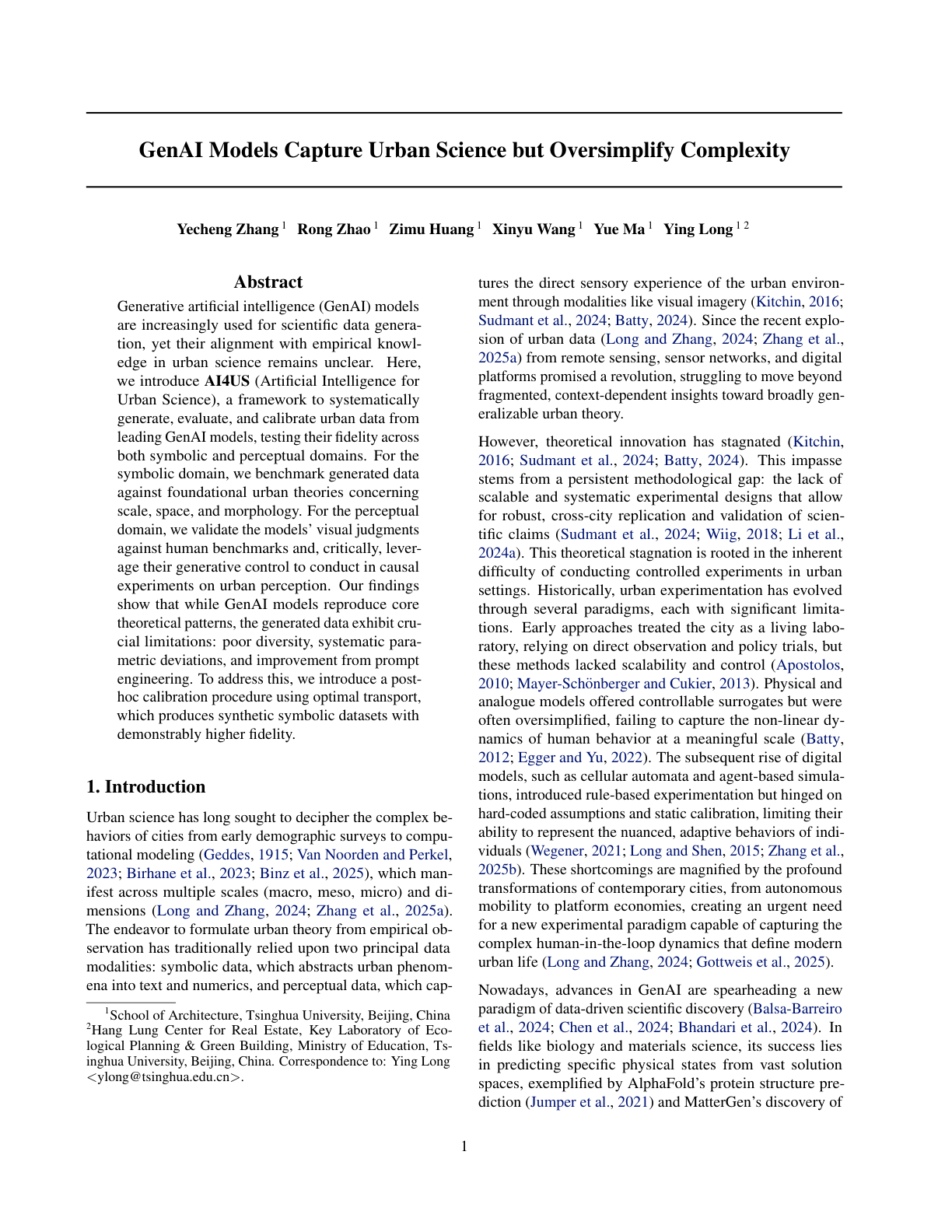
GenAI Models Capture Urban Science but Oversimplify Complexity
Yecheng Zhang, Rong Zhao, Zimu Huang, Xinyu Wang, Yue Ma, Ying Long*
Nature Communications (2nd round review).  | PDF
| PDF
- Designed the AI4US benchmark evaluating leading LLMs (GPT, Claude, GLM, DeepSeek, etc.) over 1M+ synthesis trials across symbolic reasoning and multimodal perception, fitting established scientific laws (scaling laws, distance decay, urban vitality, urban perception).
- Discovered the “group flattening” effect, systematic bias in fitting established scientific laws, and a culturally uneven baseline in LLM urban perception; proposed multi-paradigm context optimization strategies (independent/joint sampling, boundary constraints).
- 设计 AI4US 评测框架,系统评估 GPT、Claude、GLM、DeepSeek 等主流大模型在符号推理和多模态感知领域的数据合成能力,累计执行 100万+ 次实验,拟合已有科学定律(标度律、距离衰减、城市活力、城市感知)。
- 发现 “群体扁平化”效应、拟合科学定律中的系统性偏差和城市感知中的文化基准不均等现象,提出多范式上下文优化策略(独立/联合采样、边界约束)。
- AI4USベンチマークを設計し、主要LLM(GPT、Claude、GLM、DeepSeek等)の100万回以上の合成試行を通じて、記号推論とマルチモーダル知覚における科学法則(スケーリング則、距離減衰、都市活力、都市知覚)への適合を評価。
- 「集団平坦化」効果、科学法則適合における系統的バイアス、都市知覚における文化的に不均等なベースラインを発見し、マルチパラダイム文脈最適化戦略(独立/共同サンプリング、境界制約)を提案。
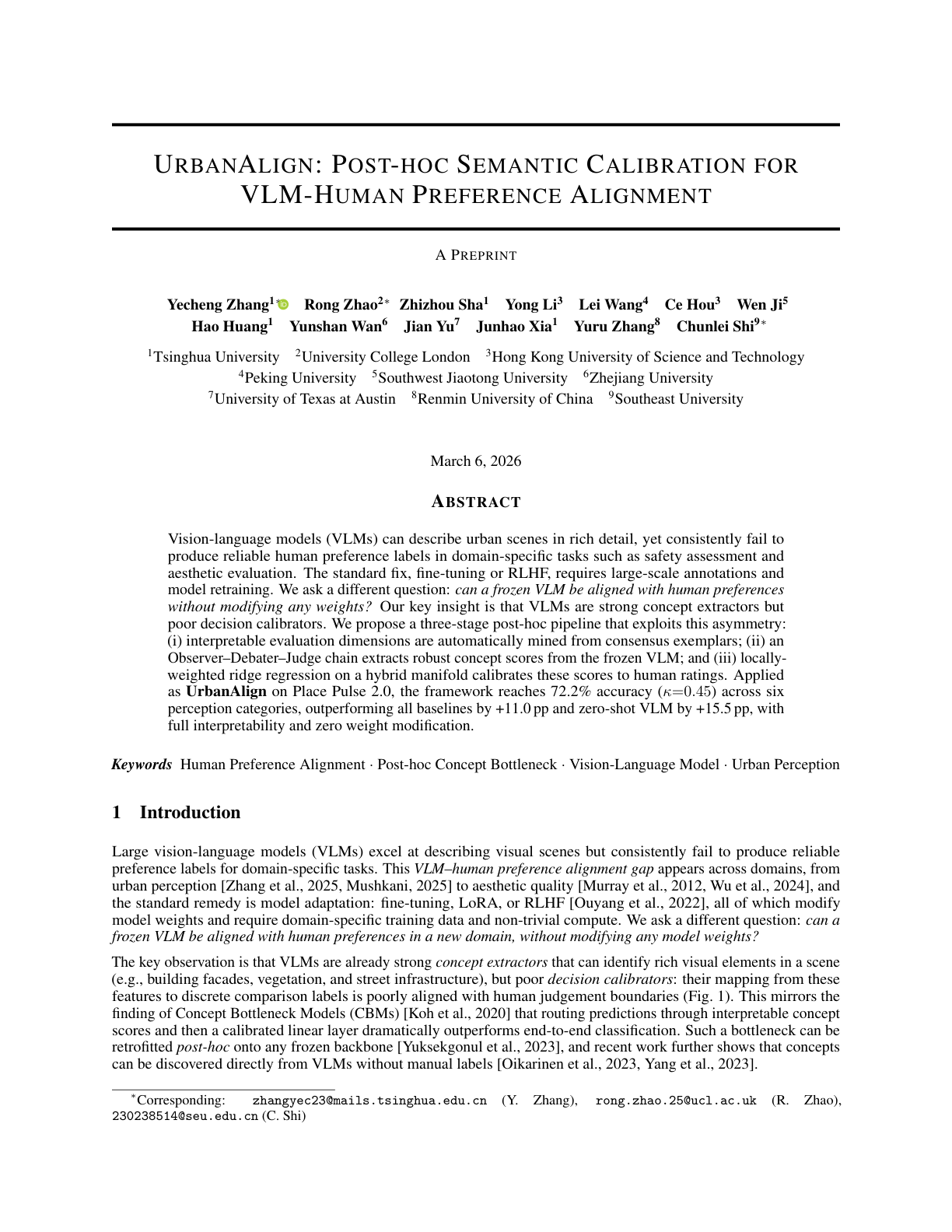
UrbanAlign: Post-hoc Semantic Calibration for VLM-Human Preference Alignment
Yecheng Zhang, Rong Zhao, Zhizhou Sha, Yong Li, Lei Wang, Ce Hou, Wen Ji, Hao Huang, Yunshan Wan, Jian Yu, Junhao Xia, Yuru Zhang, Chunlei Shi*
ECCV 2026.  | PDF
| PDF
- Proposed a training-free post-hoc concept bottleneck method to align frozen VLM outputs with human preferences — no fine-tuning, RLHF, or GPU training required.
- Designed an Observer-Debater-Judge multi-agent reasoning chain for structured scoring, and developed locally-weighted ridge regression (LWRR) on a hybrid CLIP+semantic manifold for geometric calibration.
- Achieved 72.2% accuracy (+28.8pp over raw VLM, +15.1pp over supervised baselines like Siamese Network) with full dimension-level interpretability.
- 提出免训练后置概念瓶颈方法(Post-hoc Concept Bottleneck),无需微调或RLHF即可将冻结VLM的输出与人类偏好对齐。
- 设计 Observer-Debater-Judge 多智能体推理链实现结构化评分,在CLIP+语义混合流形上通过局部加权岭回归(LWRR) 进行几何校准。
- 准确率达到 72.2%(比原始VLM提升+28.8pp,比Siamese Network等有监督基线提升+15.1pp),具备完整的维度级可解释性。
- 訓練不要の事後概念ボトルネック手法を提案し、ファインチューニングやRLHFなしで凍結VLMの出力を人間の選好に整合。
- Observer-Debater-Judge マルチエージェント推論チェーンによる構造化スコアリングを設計し、CLIP+意味的ハイブリッド多様体上の局所重み付きリッジ回帰(LWRR) による幾何学的キャリブレーションを開発。
- 精度72.2% を達成(生のVLMから+28.8pp、Siamese Networkなどの教師あり手法から+15.1pp向上)、完全な次元レベルの解釈可能性を提供。
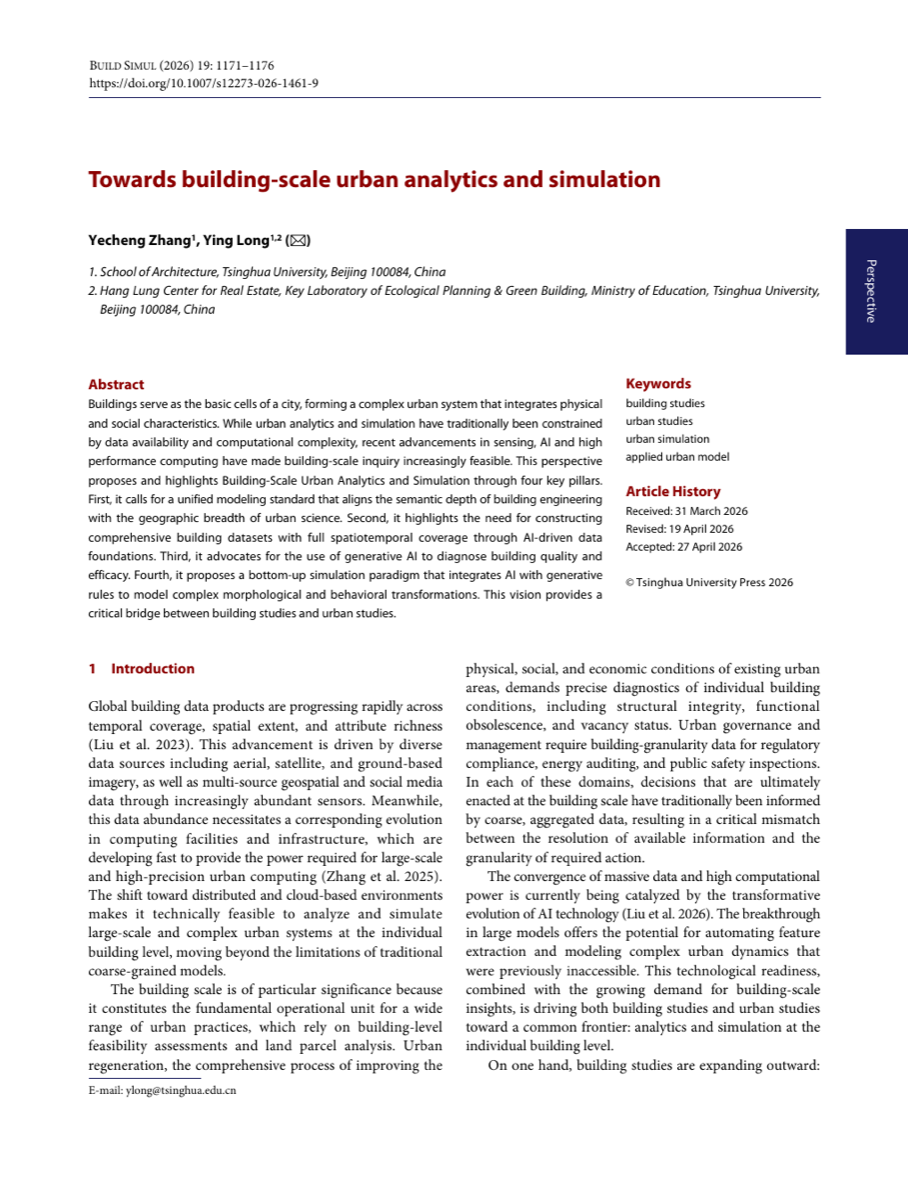
Towards Building-Scale Urban Analytics and Simulation
Yecheng Zhang, Ying Long*
Building Simulation, 19(5), 1171–1176, 2026. DOI | Publisher | PDF
- Proposed Building-Scale Urban Analytics and Simulation as a bridge between building studies and urban science.
- Defined four pillars: unified multi-scale modeling, comprehensive building data foundations, generative-AI diagnosis, and bottom-up urban simulation.
- 提出建筑尺度城市分析与模拟研究框架,连接建筑研究与城市科学。
- 明确四个支柱:多尺度统一建模、综合建筑数据底座、生成式AI诊断,以及自下而上的城市模拟。
- 建築研究と都市科学をつなぐ建築スケール都市分析・シミュレーションを提案。
- マルチスケール統一モデリング、包括的建築データ基盤、生成AI診断、ボトムアップ都市シミュレーションの4本柱を提示。
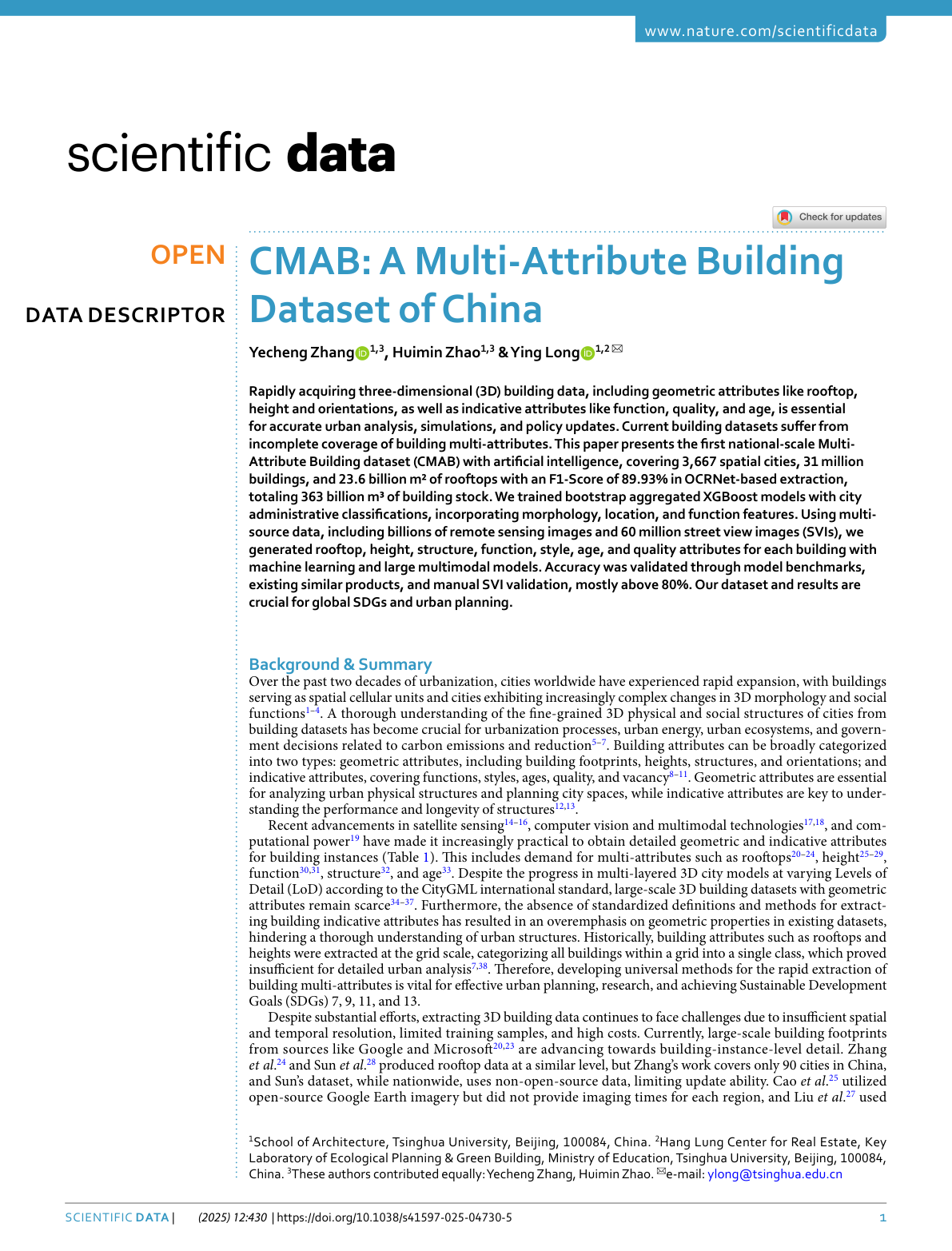
CMAB: A Multi-Attribute Building Dataset of China

Yecheng Zhang†, Huimin Zhao†, Ying Long*
Scientific Data, 12, 430, 2025. DOI | PDF
- Built China’s Multi-Attribute Building Dataset by integrating remote sensing, POI, and street-view imagery, covering 32M+ buildings with 10+ attributes nationwide.
- 45,000+ downloads on Figshare/GitHub; recognized as ESI Highly Cited Paper in Geoscience.
- Featured by Tsinghua University’s official Facebook account for research impact.
- 构建中国多属性建筑数据集(CMAB),融合遥感、POI、街景等多源数据,覆盖全国 3200万+栋建筑、10+属性。
- Figshare/GitHub累计 45,000+次下载;入选Geoscience领域 ESI高被引论文。
- 研究成果被清华大学官方Facebook账号报道推送。
- リモートセンシング、POI、ストリートビュー画像を統合し、全国3,200万棟以上の建物、10以上の属性をカバーする中国多属性建物データセット(CMAB) を構築。
- Figshare/GitHubにて 45,000回以上ダウンロード;地球科学分野の ESI高被引用論文 に認定。
- 清華大学公式Facebookアカウントにて研究成果が紹介。
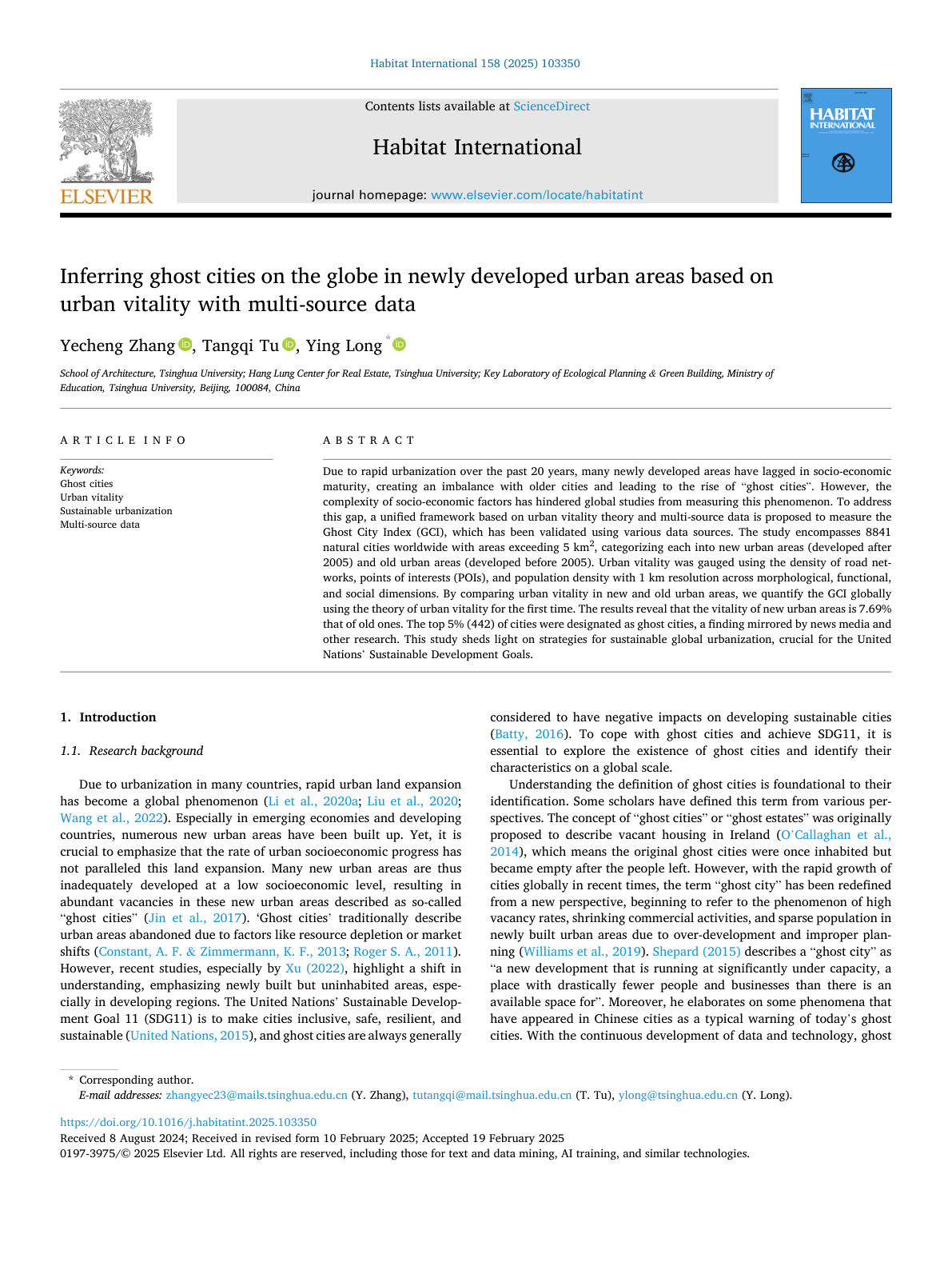
Inferring Ghost Cities on the Globe in Newly Developed Urban Areas Based on Urban Vitality with Multi-source Data
Yecheng Zhang, Tangqi Tu, Ying Long*
Habitat International, 2025. PDF
- Developed GloGCI (Global Ghost City Index) through multi-source data fusion (satellite imagery, mobility, economic indicators) with contextual multi-armed bandit sampling and ensemble learning across 10,000+ global cities.
- Recognized as ESI Highly Cited Paper in Social Science. Research reported by Popular Mechanics (one of the most influential popular science media in the US).
- 开发 GloGCI(全球鬼城指数),融合卫星影像、移动数据、经济指标等多源数据,结合上下文多臂赌博机采样与集成学习,覆盖全球 10,000+城市。
- 入选Social Science领域 ESI高被引论文。研究被美国最具影响力的科普媒体之一 Popular Mechanics 报道。
- 衛星画像、モビリティデータ、経済指標などのマルチソースデータ融合により、コンテキスト多腕バンディットサンプリングとアンサンブル学習を用いて GloGCI(グローバルゴーストシティ指数) を開発、世界 10,000都市以上 をカバー。
- 社会科学分野の ESI高被引用論文 に認定。研究成果が米国の有力科学メディア Popular Mechanics に報道される。
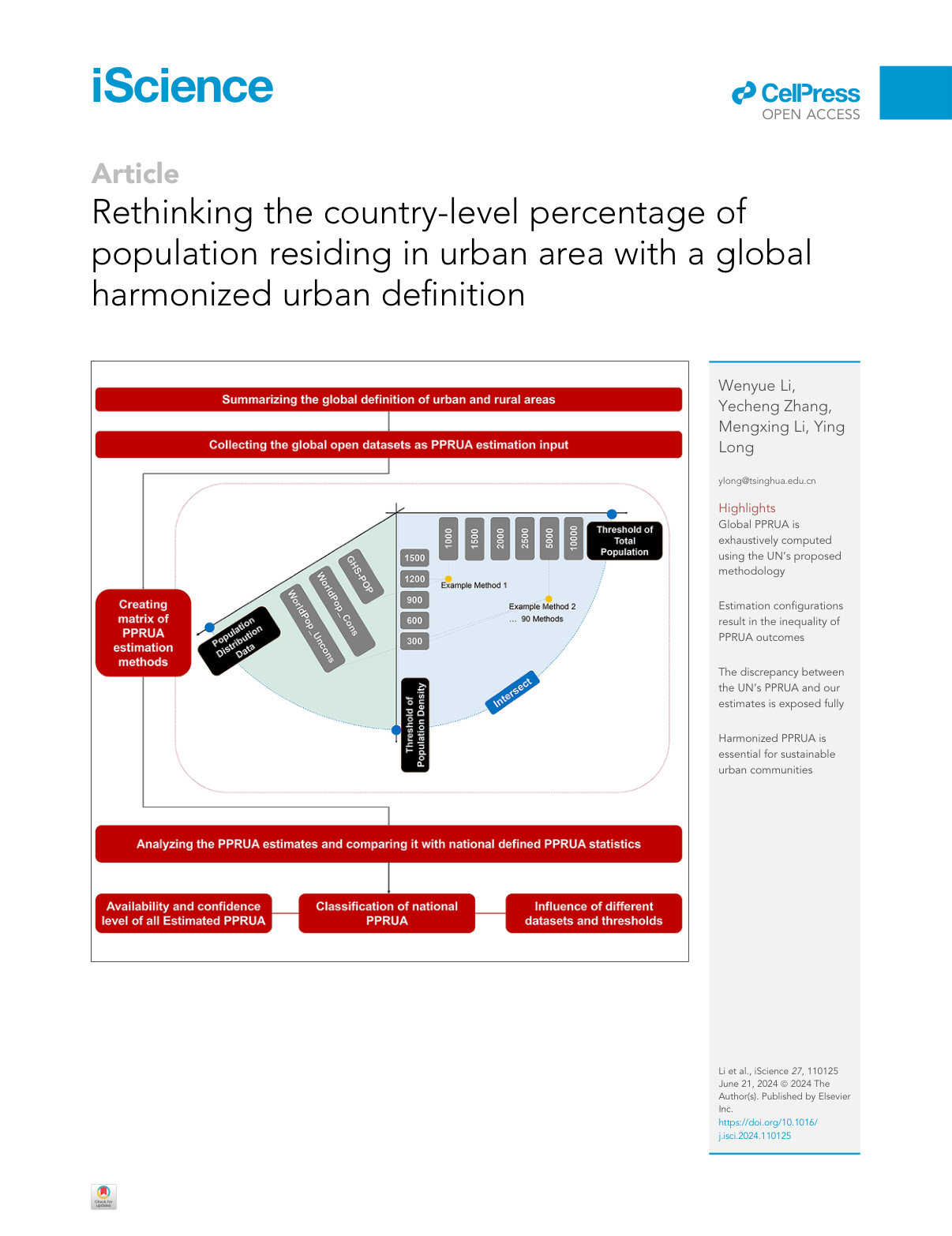
Rethinking the Country-level Percentage of Population Residing in Urban Area with a Global Harmonized Urban Definition
Wenyue Li†, Yecheng Zhang†, Mengxing Li, Ying Long*
iScience, 27, 110125, 2024. DOI | PDF
- Constructed a global harmonized urban definition (GloPPRUA) dataset, providing consistent urban-rural boundaries across countries for comparative urbanization research.
- 构建全球统一城市定义数据集(GloPPRUA),为跨国城镇化比较研究提供一致的城乡边界划分。
- 各国間の比較都市化研究のために一貫した都市・農村境界を提供するグローバル統一都市定義データセット(GloPPRUA) を構築。
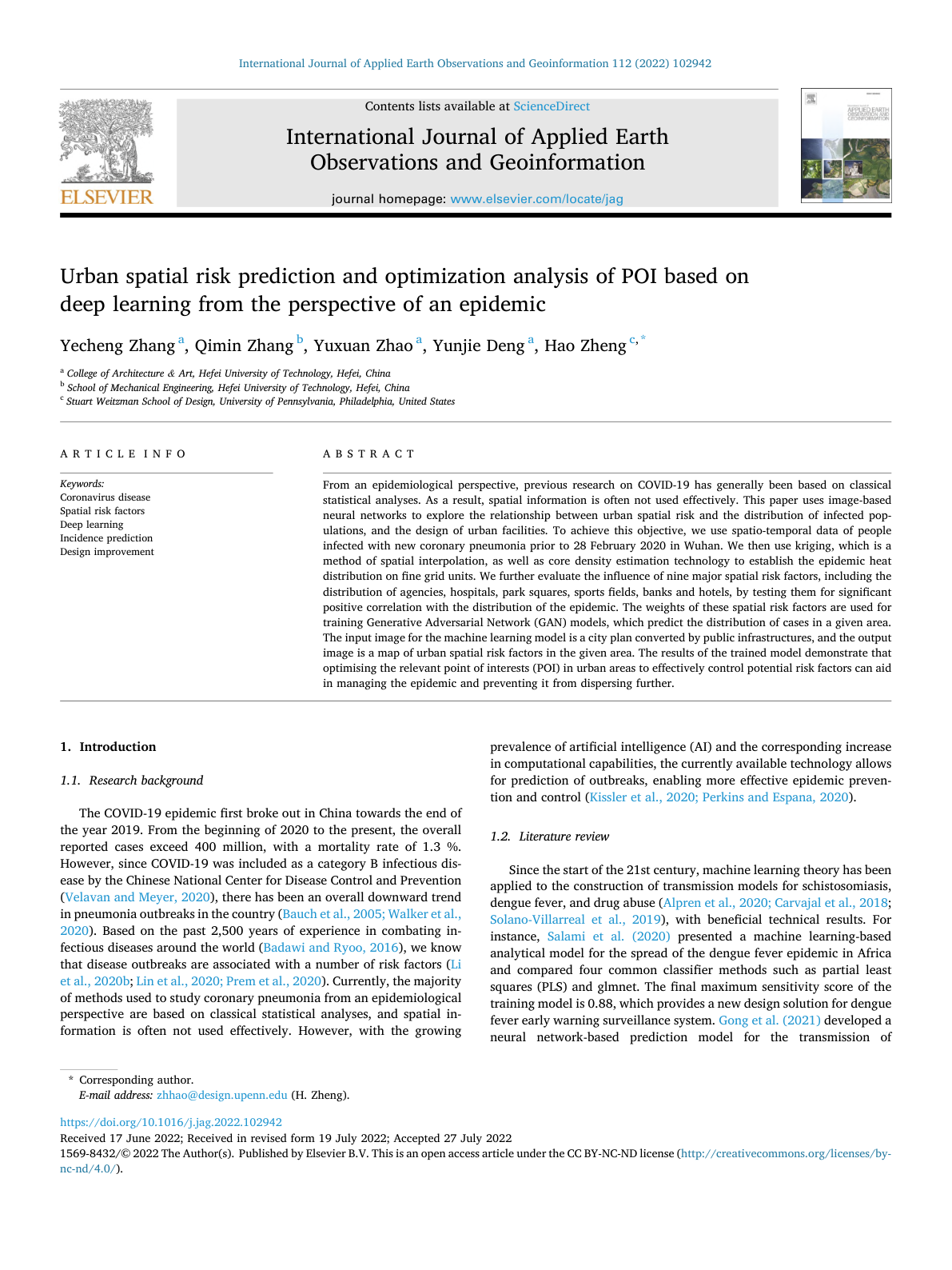
Urban Spatial Risk Prediction and Optimization Analysis of POI based on Deep Learning from the Perspective of an Epidemic
Yecheng Zhang, Qimin Zhang, Yuxuan Zhao, Yunjie Deng, Hao Zheng*
International Journal of Applied Earth Observations and Geoinformation, 112, 102942, 2022. PDF
- Applied GAN-based deep learning for urban spatial risk prediction and POI optimization during epidemic scenarios, combining spatiotemporal modeling with urban planning applications.
- 应用基于GAN的深度学习进行疫情背景下的城市空间风险预测与POI优化,将时空建模与城市规划应用相结合。
- GANベースの深層学習を用いて感染症下の都市空間リスク予測とPOI最適化を実施、時空間モデリングと都市計画への応用を融合。

WaveC2R: Wavelet-driven Coarse-to-refined Hierarchical Learning for Radar Retrieval
Chunlei Shi, Han Xu, Yinghao Li, Yi-Lin Wei, Yongchao Feng, Yecheng Zhang, Dan Niu
AAAI 2026 (CCF-A).  | PDF
| PDF
- Satellite-to-radar reflectivity inversion using wavelet-driven coarse-to-refined hierarchical learning framework for meteorological remote sensing.
- 提出基于小波驱动的粗到精层次学习框架,用于气象遥感中的卫星-雷达反射率反演。
- 気象リモートセンシングにおける衛星-レーダー反射率反転のためのウェーブレット駆動粗密階層学習フレームワークを提案。
- Shi C, Han X, Zhang Y, Wu B, Hou J, Wang J, Niu D. AWFlowS2R: A Flow-Based New Paradigm for All-Weather Satellite-to-Radar Retrieval. arXiv, 2026.
- Wang L, Hou C, Zhang Y, He J. Measuring Solar Radiation and Spatio-temporal Distribution in Different Street Network Direction through Solar Trajectories and Street View Images. *International Journal of Applied Earth Observation and Geoinformation, 132, 104058, 2024. PDF
- Long Y, Zhao H, Zhang Y. 新城市科学:技术、计算、变革与应用. *城市规划 CITY PLANNING REVIEW, 48, 2024. DOI | PDF
- Li Y, Zhang Y, Wu Q, Xue R, Wang X, Si M, Zhang Y. Greening the Concrete Jungle: Unveiling the Co-mitigation of Greenspace Configuration on PM2.5 and Land Surface Temperature with Explanatory Machine Learning. *Urban Forestry & Urban Greening, 88, 128086, 2023. PDF
- Ding X, Zhang Y, Zhang Y, …, Haick H, Zhang M. Modular Assembly of MXene Frameworks for Noninvasive Disease Diagnosis via Urinary Volatiles. ACS Nano, 16, 17376–17388, 2022. DOI | PDF
- Yao J, Jian Y, Shen Y, …, Zhang Y. Decoding the Spatial Heterogeneity of Bike-Sharing Impacts. Journal of Urban Planning and Development, 2025. DOI
- Zhang Y, et al. Generative Design Method of Building Group Based on AIP Assessment. UIA World Congress of Architects, Copenhagen, 2023.
Honors and Awards荣誉奖励受賞歴
- 2026.04 ESI Highly Cited Paper (Social Science), Ghost Cities paper in Habitat International.
- 2025.11 ESI Highly Cited Paper (Geoscience), CMAB paper in Scientific Data.
- 2025.11 “GIS Rising Star” Award (全国高校GIS新秀, 10 nationwide) & Session Chair, The 13th China College GIS Forum, Shanghai.
- 2025.11 “新城市科学” Highly Cited Paper, CNKI Top 20 Most-Cited (2024-2025), 城市规划.
- 2025.10 Jin Jingchang Outstanding Paper Award (金经昌城市规划优秀论文佳作奖, 22nd edition), Shanghai.
- 2025.08 Outstanding Teaching Assistant (Top 5%), Tsinghua University, 2024-2025 Fall.
- 2025.05 “Academic Rising Star” Nominee (学术新秀, 10 university-wide, sole nominee from School of Architecture), Tsinghua University.
- 2025.05 Exhibitor, China Pavilion, 19th Venice Architecture Biennale, Venice, Italy.
- 2025.01 Outstanding Case Award for “AI-Empowered Planning”, Urban Planning Society of China.
- 2023.05 Exhibitor, China Pavilion, 18th Venice Architecture Biennale, Venice, Italy.
- 2026.04 ESI高被引论文(Social Science领域),鬼城论文,Habitat International。
- 2025.11 ESI高被引论文(Geoscience领域),CMAB论文,Scientific Data。
- 2025.11 全国高校GIS新秀奖(全国10人)并主持专场论坛,第十三届全国高校GIS论坛,上海。
- 2025.11 “新城市科学”高被引论文,中国知网《城市规划》2024-2025年度高被引论文TOP20榜单。
- 2025.10 金经昌城市规划优秀论文佳作奖(第22届),上海。
- 2025.08 优秀研究生助教(前5%),清华大学2024-2025学年秋季学期。
- 2025.05 清华大学第二十九届研究生 “学术新秀”候选人(全校10人,建筑学院唯一推荐)。
- 2025.05 参展第19届威尼斯国际建筑双年展中国国家馆,意大利威尼斯。
- 2025.01 中国城市规划学会 “AI赋能规划”优秀案例奖。
- 2023.05 参展第18届威尼斯国际建筑双年展中国国家馆,意大利威尼斯。
- 2026.04 ESI高被引用論文(社会科学分野)、ゴーストシティ論文、Habitat International。
- 2025.11 ESI高被引用論文(地球科学分野)、CMAB論文、Scientific Data。
- 2025.11 「GIS新星賞」受賞(全国10名)、第13回中国大学GISフォーラムにてセッション座長、上海。
- 2025.11 「新城市科学」高被引用論文、CNKI被引用数Top20(2024-2025)、城市规划。
- 2025.10 金経昌都市計画優秀論文賞(第22回)、上海。
- 2025.08 優秀ティーチングアシスタント(上位5%)、清華大学2024-2025秋学期。
- 2025.05 清華大学第29回大学院生 「学術新星」候補(全学10名、建築学院唯一の推薦)。
- 2025.05 第19回ヴェネチア・ビエンナーレ国際建築展 中国館に出展、イタリア・ヴェネチア。
- 2025.01 中国都市計画学会 「AI活用計画」優秀事例賞。
- 2023.05 第18回ヴェネチア・ビエンナーレ国際建築展 中国館に出展、イタリア・ヴェネチア。
Educations教育背景学歴
- 2023.09 - present, Ph.D. in Urban Planning (AI for Urban Science), Tsinghua University, Beijing, China. Advisor: Prof. Ying Long.
- 2018.09 - 2023.06, B.Eng. in Urban Planning, Hefei University of Technology, Hefei, China.
- 2023.09 - 至今,城市规划博士(AI for Urban Science方向),清华大学,北京。导师:龙瀛教授。
- 2018.09 - 2023.06,城乡规划学士,合肥工业大学,合肥。
- 2023.09 - 現在,都市計画博士課程(AI for Urban Science),清華大学,北京。指導教員:龍瀛教授。
- 2018.09 - 2023.06,都市計画学士,合肥工業大学,合肥。
Internship Projects实习项目インターンシッププロジェクト
ByteDance (Lark) · Base AI | LLM Algorithm Intern | 2026.05 – Present Responsible for post-training Doubao Seed 2 for Lark Base AI scenarios, covering Spec generation, Verifier repair, CodeAct, and the E2E Judge/Reward system, and building vertical Agent model capabilities for enterprise-native B2B scenarios.
[1] Built the Judge Infra Model. To internalize GPT-level evaluation, built a three-layer Category–Rubric–Mode rubric system covering the five core domains of Lark Base (Table/Workflow/Dashboard/Permission/Form), graded by severity levels S0–S1–S2 and semantic-checker levels L1–L2–L3. Built the Judge–Fix–Router pipeline (voting, early stopping, bypass, and information passing) and synthesized judge trajectories. Post-trained the Judge Model on Seed 2.0 by designing curriculum reinforcement learning for the Lark Base Rubric Model: started with Strict-SFT for cold start, then introduced same-query multi-rollout GRPO centered on stage-wise dynamic Rubric:Mode weighting, together with a Category→Rubric→Mode→Reason structured chain of thought and multidimensional E2E Judge signals, strengthening fine-grained rule-boundary recognition, issue localization, and false-positive control. Accuracy matched GPT-5.6, while stability and coverage surpassed it (Vote agreement +35%; Rubric coverage +45%).
[2] Built the Fix Model. To stabilize the fix/rewrite capability interfacing with the Rubric Model, generated 12,000 Judge–Fix and E2E trajectories and applied heterogeneous multi-model trajectory distillation to extract fix-capability information from multiple heterogeneous advanced models at each stage of the Judge→Fix→Router pipeline. Trained the Fix Model on Seed 2.0 using SFT + RFT + PPO; E2E feedback signals showed that its accuracy surpassed GPT-5.6 by 20%.
[3] Built the Verifier Agent. Compared with the sparse decisions of conventional LLM-as-a-Judge, sampled multiband token probabilities (logprobs) from the Judge Infra Model’s local Rubric decisions before and after fixes, and extracted dense fix–judge feedback signals through K-way rollout sampling and precise logprob extraction. This significantly improved accuracy, coverage, and stability over conventional LLM-as-a-Judge. Engineering of the Judge–Fix pipeline—including early stopping, V/Q voting-based output gating, and mixed-precision model inference—improved token utilization efficiency by 58%; E2E human–model agreement improved by 60%, with 11,000+ training trajectories synthesized and 9,197 valid samples retained.
[4] Advanced joint training of the Spec Agent, Verifier Agent, and Code Agent. Advanced multi-model joint training across Spec/Plan, CodeAct, and Judge/Reward. Used previously accumulated Spec/Verifier annotations, Fix trajectories, and E2E results to train a business Judge Model, converting multidimensional feedback—including requirement coverage, configuration correctness, cross-module dependencies, and overall usability—into rewards for CodeAct RL, jointly improving requirement understanding, verification and repair, and end-to-end execution success rate.
[5] Developed AutoResearch. Developed a self-evolving dynamic harness for PE optimization, deeply adapted to the Base Spec generation scenario. It performs multi-rollout sampling against the same prompt baseline, uses cross-batch adversarial synthesis to eliminate sampling noise and identify shared root causes, and passes evidence, stability, adversarial-robustness, and net-gain gates to synthesize high-leverage, low-regression prompt patches.
Nanjing NUIST Meteorological Science & Technology Institute | Doctoral Practice (Excellent Evaluation) | 2025
- Systematically benchmarked 10+ deep learning architectures (CNN/GAN/Diffusion/Transformer/Flow Matching) for FY-4B satellite-to-radar composite reflectivity inversion using 22-channel input (15 base + 7 hand-crafted BTD features encoding cloud phase and moisture gradients); designed exponentially-weighted loss to address extreme class imbalance.
- Conditional Flow Matching (CFM) achieved CSI +7.2% and FAR -30% over baseline; zero-shot geographic transfer to radar-blind Xinjiang validated with GPM satellite data.
字节跳动(飞书)· Base AI | 大模型算法实习 | 2026.05 – 至今
- 构建 Judge Infra Model:为内部化 GPT 级评测,构建 Category–Rubric–Mode 三层 Rubric 体系,覆盖多维表格五大核心域(Table/Workflow/Dashboard/Permission/Form)共 199 个违规模式,按严重度 S0–S1–S2 与 checker L1–L2–L3 双维分级;复用 Judge-Fix 全过程数据构建训练集,基于 Seed 2.0(300B)基座(SFT + GRPO)后训练 Judge 模型,准确率达 GPT-5.6 Sol XHigh(4000B)、稳定性与覆盖度超过十倍参数模型(Vote 一致率 +75%、Rubric 覆盖率 +80%),作为数据合成评测底座。
- 将 Judge 模型组装为 Verifier Agent:相较传统 LLM-as-Judge 的稀疏判定,采样 Judge Infra Model 输出局部 Rubric 判定在 fix 前后的 token 采样多档概率 logprob,经多路 rollout(K)采样精准提取 fix-judge 反馈的稠密信号;在准确性、覆盖度、稳定性上相较 LLM-as-Judge 显著提升,并由 Judge-Fix 链路的工程设计(早停、投票 V/Q 准出、混合精度推理)提升 token 利用效率 58%——E2E 人机一致性 +60%,1.1万+ 条轨迹(9,197 条有效)。
- 研发 AutoResearch:基于 SkillOpt 1&2 并结合 Base Spec 生成场景深度改造的自进化 PE 优化动态 Harness,多路 rollout 采样 + 跨批次对抗式综合消除采样噪声、发现共性根因,经证据/稳定性/抗对抗/净收益门控合成高杠杆低回归的 Prompt patch,自进化闭环,豆包模型(Seed 2.0 Lite 基座)在数据库生成任务提升 +30 pp。
- 参与 Spec/Plan、CodeAct、Judge/Reward 多模型合训(CodeAct Judge 通过率 40.34% → 48.74%,P50 延迟 3.1 分钟 → 23 秒)。
南京信息工程大学气象科技研究院 | 博士实践(优秀评价)| 2025
- 系统基准测试 10+深度学习架构(CNN/GAN/Diffusion/Transformer/Flow Matching),用于FY-4B卫星-雷达组合反射率反演,使用 22通道输入(15基础通道+7个手工设计BTD特征,编码云相态和水汽梯度);设计指数加权损失函数解决极端类别不平衡问题。
- 条件流匹配(CFM)在CSI上提升 +7.2%,FAR降低 -30%;实现至无雷达覆盖的新疆地区的零样本地理迁移,使用GPM卫星数据验证。
ByteDance(Lark)· Base AI | LLMアルゴリズムインターン | 2026.05 – 現在
- Judge Infra Model を構築:GPT級の評価を内部化するため、Category–Rubric–Mode 3層ルーブリック体系を構築し、Table/Workflow/Dashboard/Permission/Formの5つの中核ドメインをカバー、199の違反モードを重大度S0–S1–S2とchecker L1–L2–L3の二次元で等級付け;Judge-Fix全过程データで訓練セットを構築し、Seed 2.0(300B)基盤(SFT+GRPO)で Judgeモデル を後訓練、GPT-5.6 Sol XHigh(4000B)と同等の精度、安定性・カバレッジで10倍規模モデルを上回る(投票一致率+75%、Rubricカバレッジ+80%)、データ合成の評価基盤として。
- Judgeモデルを Verifier Agent として組み立て:従来のLLM-as-Judgeのスパース判定に対し、Judge Infra Modelをサンプリングして局所Rubric判定を出力し、各判定のfix前後のtokenサンプリング多段階確率logprobから、多路rollout(K)サンプリングでfix-judgeフィードバックの稠密信号を精密抽出;正確性・カバレッジ・安定性でLLM-as-Judgeを大幅に上回り、Judge-Fixチェーンの工学設計(早期停止、V/Q投票、混合精度推論)で token効率 58% を向上——E2Eの人間・機械一致率 +60%、11,000件以上の軌跡(有効9,197件)。
- AutoResearch を開発:SkillOpt 1&2をBase Spec生成シナリオ向けに深く改造した自己進化型PE最適化ダイナミックHarness、多路rolloutサンプリング+クロスバッチ敵対的統合でサンプリングノイズを除去し共通根因を発見、証拠/安定性/抗敵対/純利益ゲートでハイレバレッジ・低回帰のPrompt patchを合成、自己進化ループ、豆包モデル(Seed 2.0 Lite基盤)でDB生成タスク +30 pp を向上。
- Spec/Plan、CodeAct、Judge/Rewardの多モデル共訓練に参加(CodeAct Judge通過率 40.34% → 48.74%、P50遅延 3.1分 → 23秒)。
南京情報工程大学気象科学技術研究院 | 博士実践(優秀評価)| 2025
- FY-4B衛星-レーダー合成反射率反転のために 10以上の深層学習アーキテクチャ(CNN/GAN/Diffusion/Transformer/Flow Matching)を体系的にベンチマーク、22チャネル入力(15ベース+7手作りBTD特徴量、雲相と水蒸気勾配をエンコード)を使用;極端なクラス不均衡に対処する指数加重損失を設計。
- 条件付きフローマッチング(CFM)がCSI +7.2%、FAR -30% の改善を達成;GPM衛星データで検証されたレーダー未カバー地域新疆へのゼロショット地理的転移を実現。
Invited Talks & Conferences学术报告与会议招待講演・学会発表
- 2025.11, The 13th China College GIS Forum — Rising Star Forum, Shanghai. Session Chair & Speaker.
- 2025.10, China Urban Planning Informatization Annual Conference, Foshan. Poster.
- 2025.03, AAG 2025 (American Association of Geographers Annual Meeting), Detroit, USA.
- 2024.11, Tsinghua University “Future Urban Construction” Ph.D. Forum, Beijing.
- 2024.06, Applied Urban Modelling (AUM2024), University of Cambridge, UK.
- 2023.08, The First Research Summit of Urban Science, Beijing.
- 2023.08, Global Smart Cities Summit (GSCS) & ICUI, Hong Kong.
- 2023.07, UIA World Congress of Architects, Copenhagen, Denmark.
- 2023.06, Tongji University Architectural DigitalFUTURES workshop “Emerging Planetarism”, Shanghai. Teaching Assistant.
- 2022.09, CUSR Urban Big Data Annual Meeting, Beijing.
- 2022.07, 4th International Conference on Computational Design and Robotic Fabrication, Shanghai.
Academic Service学术服务学術活動
- Invited Reviewer, Nature Cities (Nature Portfolio), 2024–present.
- Invited Reviewer, Scientific Data (Nature Portfolio), 2024–present.
- Invited Reviewer, npj Urban Sustainability (Nature Portfolio), 2024–present.
- Invited Reviewer, Cities (Elsevier), 2023–present.
- Invited Reviewer, Computers, Environment and Urban Systems (Elsevier), 2023–present.
- Invited Reviewer, Verixiv, 2025–present.
Open-source Datasets开源数据集オープンソースデータセット
- CMAB — China’s Multi-Attribute Building Dataset (32M+ buildings, 45,000+ downloads, ESI Highly Cited). Dataset
- GloGCI — Global Ghost City Index (10,000+ cities worldwide, 4,000+ downloads).
- GloPPRUA — Global Harmonized Urban Definition.
- AI4US — Generative AI Benchmarks for Urban Science (2,000+ downloads).
- CMAB — 中国多属性建筑数据集(3200万+栋建筑,45,000+次下载,ESI高被引)。数据集
- GloGCI — 全球鬼城指数(覆盖全球10,000+城市,4,000+次下载)。
- GloPPRUA — 全球统一城市定义数据集。
- AI4US — 城市科学生成式AI评测基准(2,000+次下载)。
- CMAB — 中国多属性建物データセット(3,200万棟以上、45,000回以上ダウンロード、ESI高被引用)。データセット
- GloGCI — グローバルゴーストシティ指数(世界10,000都市以上、4,000回以上ダウンロード)。
- GloPPRUA — グローバル統一都市定義データセット。
- AI4US — 都市科学のための生成AIベンチマーク(2,000回以上ダウンロード)。